
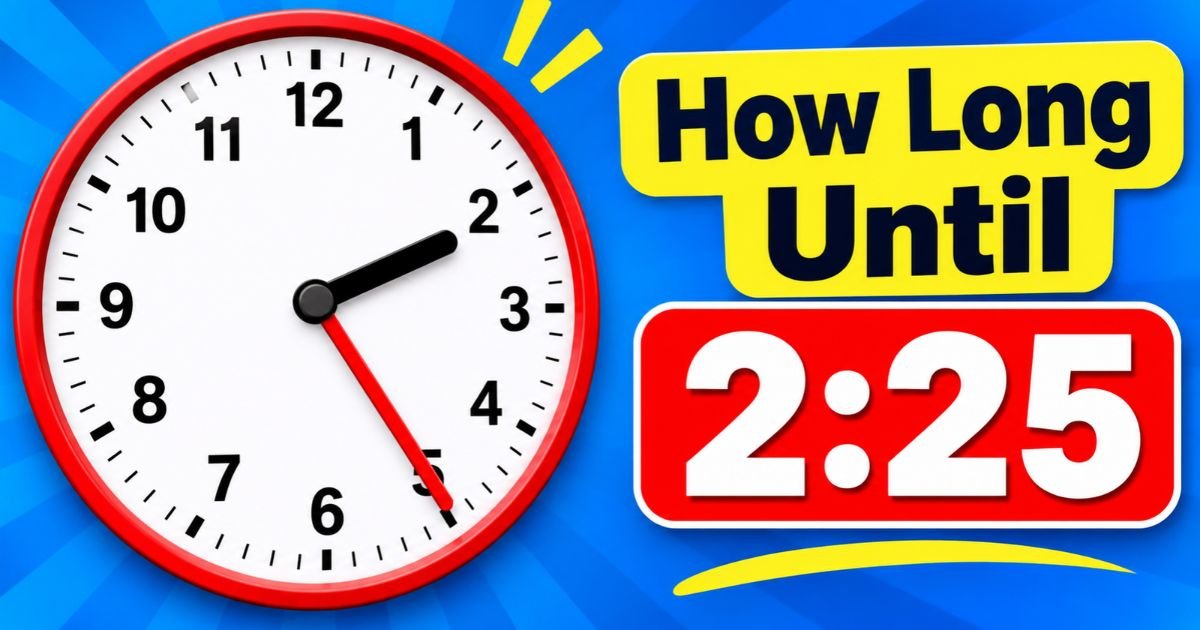

You glance at the clock and wonder how much time is left before 2:25. Maybe a meeting starts then. Maybe a pickup, a deadline, or the last minutes of a lunch break. The answer depends on one thing: what time it is right now.
This guide gives you the fast answer first. Then it shows you how to work it out yourself in under ten seconds, with no app needed. You will also see AM and PM differences, midnight rollovers, real examples, a minutes table, and the mistakes that cause people to show up late.
Time Remaining Until 2:25 PM
Here is the simplest way to see your exact countdown: take the current time and subtract it from 2:25 PM.
Here is a live example. At 11:58 AM, there are 2 hours and 27 minutes until 2:25 PM. That equals 147 minutes.
Your result changes every minute, so use this formula for any starting time:
- Count the minutes to the next full hour.
- Add the full hours between that hour and 2:00 PM.
- Add the final 25 minutes.
For a precise countdown that includes seconds, a live timer on your phone or computer is the best tool. Use the method below when you want to understand the number or check it yourself.
Quick Answer: How Long Until 2:25?
The time until 2:25 equals 2:25 minus the current time. If it is before 2:25 PM today, the answer is a positive number of hours and minutes. If it is already past 2:25 PM, the next 2:25 PM is tomorrow, so you add 24 hours first.
Three quick examples:
- It is 1:25 PM now, so 2:25 PM is 1 hour away.
- It is 2:00 PM now, so 2:25 PM is 25 minutes away.
- It is 3:00 PM now, so the next 2:25 PM is 23 hours and 25 minutes away.
That is the whole idea. Everything else in this guide is about doing it faster and avoiding mistakes.
Why “How Long Until” Questions Matter
People search “how long until” because time pressure is real. A few minutes of misjudgment can mean a missed train, a late meeting, or an overcooked dinner.
Here is why this small question comes up so often:
- Schedules run in blocks. Many calendars, classes, and shifts break the day into set chunks, and 2:25 PM falls right in the middle of the afternoon.
- Our sense of time is unreliable. Most people feel that twenty minutes is either “plenty” or “almost gone.” A real number removes the guesswork.
- Planning needs a target. Once you know you have 47 minutes, you can decide whether to start a task or prepare for the next one.
- Digital tools make it a habit. Voice assistants, widgets, and search engines made countdown questions part of daily life.
Knowing the exact gap also lets you plan a buffer. A buffer is spare time you protect so small delays do not become big problems.
At-a-Glance: Time Remaining Until 2:25
Use this table as a fast reference for 2:25 PM today. It assumes you are counting forward from the time shown.
| Current Time | Time Until 2:25 PM | Total Minutes |
| 11:25 AM | 3 hours | 180 |
| 12:00 PM | 2 hours 25 minutes | 145 |
| 12:25 PM | 2 hours | 120 |
| 1:00 PM | 1 hour 25 minutes | 85 |
| 1:25 PM | 1 hour | 60 |
| 1:55 PM | 30 minutes | 30 |
| 2:10 PM | 15 minutes | 15 |
| 2:20 PM | 5 minutes | 5 |
Some key facts about the target itself:
- 2:25 PM equals 14:25 in 24-hour time.
- In military time, it is written 1425.
- It sits 865 minutes after midnight.
- 2:25 AM, by comparison, sits only 145 minutes after midnight.
Related Post: How Long Until 3:25? Instant Countdown Guide + Easy Calculation Methos
How to Calculate Time Until 2:25 (Step-by-Step)
You do not need a calculator for this. Follow these five steps and you will get the right answer every time.
Step 1: Identify the Current Time
Look at a clock you trust. A phone clock is best because it syncs with network time. A wall clock or microwave display can drift by several minutes.
Write the time down as hours and minutes. For example: 11:58 AM.
Step 2: Decide Which 2:25 You Mean
This is the step most guides skip. There are two 2:25 moments every day: 2:25 AM and 2:25 PM.
- If you are asking during the day about an afternoon event, you almost certainly mean 2:25 PM.
- If you are asking late at night or very early in the morning, you may mean 2:25 AM.
- If the time you want has already passed today, you are counting toward tomorrow.
When in doubt, switch to the 24-hour clock. 14:25 is always the afternoon one and 02:25 is always the early morning one. No confusion.
Step 3: Subtract Hours First
Take the hour of your target and subtract the current hour. For 2:25 PM, use 14 on the 24-hour clock.
Example: the current time is 11:58 AM, which is 11:58 in 24-hour time. The hour gap is 14 minus 11, which is 3 hours.
Step 4: Subtract or Add Minutes
Now compare the minutes. The target has 25 minutes. The current time has 58 minutes.
Since 25 is smaller than 58, you cannot subtract directly. Borrow one hour. Take 1 hour off the hour gap (3 becomes 2) and add 60 to the target minutes (25 becomes 85). Now subtract: 85 minus 58 equals 27 minutes.
Step 5: Combine for Final Answer
Put the hours and minutes together. In our example, that is 2 hours and 27 minutes.
To check your work, convert to minutes: 2 hours times 60 is 120, plus 27 equals 147 minutes. If you add 147 minutes to 11:58 AM, you land on 2:25 PM.
A faster mental shortcut: round to the nearest friendly time. From 11:58, it is 2 minutes to noon. From noon to 2:25 is 2 hours and 25 minutes. Add them: 2 hours and 27 minutes. Same answer, much quicker.
2:25 AM vs 2:25 PM: Know the Difference
The two times are exactly 12 hours apart, but they feel very different in real life.
| Feature | 2:25 AM | 2:25 PM |
| 24-hour format | 02:25 | 14:25 |
| Military time | 0225 | 1425 |
| Minutes after midnight | 145 | 865 |
| Part of the day | Deep night | Early afternoon |
| Typical use | Alarms, flights, overnight shifts | Meetings, school, appointments |
Here is how the AM and PM choice changes the math:
- Counting from the morning to 2:25 PM: the gap is usually a few hours, as in our 11:58 AM example.
- Counting from the evening to 2:25 AM: you cross midnight. From 11:00 PM, it is 1 hour to midnight plus 2 hours 25 minutes, so 3 hours 25 minutes.
- Counting from the morning to the next 2:25 AM: this is a long wait. From 11:58 AM, it is 14 hours and 27 minutes.
A useful habit: whenever you write or say the time, add AM or PM. “2:25” alone invites mistakes, especially across time zones.
Real-Life Scenarios: When This Question Comes Up
Examples make the method stick. Here are four situations where the 2:25 countdown is useful.
Scenario 1: Countdown to a Meeting
Your video call starts at 2:25 PM. It is now 1:40 PM. The gap is 45 minutes.
Do not treat all 45 minutes as work time. Subtract 10 minutes to open the call link and check your audio, and another 5 to grab water and review your notes. Your real focus window is about 30 minutes, so choose a task that fits inside it.
Scenario 2: Early Morning Wake-Up
You have a 2:25 AM flight check-in or a night shift. You plan to sleep from 9:50 PM. From 9:50 PM to midnight is 2 hours 10 minutes. From midnight to 2:25 AM is 2 hours 25 minutes. Total sleep time: 4 hours 35 minutes.
That is short, so you might move bedtime earlier or plan a nap. Knowing the exact number helps you make that choice before you are tired, not after.
Scenario 3: Cooking or Baking Timer
A roast needs 75 minutes, and dinner guests or a lunch break needs it ready at 2:25 PM. Count backward: 2:25 PM minus 75 minutes is 1:10 PM.
Backward counting is the same skill as forward counting. You subtract the duration from the target time. Set an oven timer for 75 minutes at 1:10 PM, and add a reminder 10 minutes before so you can check it.
Scenario 4: Study or Work Session
You want to finish a study block by 2:25 PM using 25 minute focus sessions with 5 minute breaks. Start at 12:55 PM.
- 12:55 to 1:20 PM: focus session 1.
- 1:20 to 1:25 PM: break.
- 1:25 to 1:50 PM: focus session 2.
- 1:50 to 1:55 PM: break.
- 1:55 to 2:20 PM: focus session 3.
- 2:20 to 2:25 PM: final break and wrap up.
That is 90 minutes in total, which lands exactly on 2:25 PM. Planning a schedule around a fixed endpoint removes the stress of watching the clock.
Time Breakdown Table: Minutes Remaining by Interval
Use this table when you want a more precise picture in the last two hours before 2:25 PM.
| Current Time | Minutes Until 2:25 PM |
| 12:25 PM | 120 |
| 12:45 PM | 100 |
| 12:55 PM | 90 |
| 1:10 PM | 75 |
| 1:25 PM | 60 |
| 1:40 PM | 45 |
| 1:55 PM | 30 |
| 2:05 PM | 20 |
| 2:15 PM | 10 |
| 2:20 PM | 5 |
| 2:24 PM | 1 |
Notice the pattern. Each 5 minutes on the clock equals 5 fewer minutes in the countdown. The relationship is simple, so once you know one row, you can fill in the rest.
Common Mistakes to Avoid
Most wrong answers come from a handful of repeat errors. Watch for these:
- Forgetting to borrow an hour. When the current minutes are larger than 25, you must borrow. Skipping this step gives an answer that is off by an hour.
- Mixing AM and PM. Counting toward 2:25 AM when you meant 2:25 PM is the classic slip.
- Treating minutes as decimals. 1 hour 30 minutes is not 1.30 hours. It is 1.5 hours. Keep hours and minutes separate until the end.
- Ignoring that time has already passed. If it is 3:10 PM, 2:25 PM today is gone. The next one is tomorrow.
- Forgetting time zones. A 2:25 PM meeting in another city may be a different local time for you. Confirm the zone before you count.
- Relying on an unsynced clock. A wall clock that runs 4 minutes slow turns a safe margin into a late arrival.
- Using the whole gap as work time. Travel, setup, and focus switching all use up minutes you thought you had.
Do’s and Don’ts for Accurate Time Calculations
| Do | Don’t |
| Check a synced phone or computer clock | Trust a clock that has not been set in months |
| Write AM or PM every time | Say “2:25” and assume everyone knows which one |
| Use the 24-hour clock when you are unsure | Guess when crossing noon or midnight |
| Verify your answer by adding it back | Stop at the first number you get |
| Plan a 5 to 10 minute buffer | Plan to arrive at the exact minute |
| Confirm the time zone for remote events | Assume the other person shares your local time |
| Set an alarm for 2:25 PM and a warning 10 minutes before | Rely on memory alone |
Key Terminology & Related Concepts
A few terms show up around this topic. Knowing them makes time calculators and countdown tools easier to use.
- Countdown timer: a tool that shows the time remaining until a set moment, often down to the second.
- Time calculator: a tool that adds, subtracts, or compares times and durations.
- 12-hour clock: the format that uses AM and PM, so 2:25 PM is the afternoon version.
- 24-hour clock: the format that runs from 00:00 to 23:59, so 2:25 PM becomes 14:25.
- Military time: the 24-hour format written without a colon, such as 1425. It is common in aviation, healthcare, and logistics.
- Minutes after midnight: a running count of minutes since 12:00 AM. 2:25 PM is 865, and 2:25 AM is 145.
- Time zone: a region that shares the same standard time. A 2:25 PM meeting means different things in different zones.
- UTC (Coordinated Universal Time): the global reference time used to sync clocks across regions.
- Buffer time: a planned gap that protects you from small delays.
- Time blocking: a planning method where you assign tasks to set blocks on your calendar.
Tips for Faster Mental Time Math
With practice, you can answer “how long until 2:25” almost instantly. These habits help.
- Use anchor points. Think in terms of the nearest full hour or half hour, then adjust. From 1:50 PM, you are 10 minutes from 2:00 and 25 minutes past it, so 35 minutes total.
- Switch to 24-hour time for a week. Seeing 14:25 trains your brain to count forward without worrying about AM and PM.
- Count in chunks of 5. Most clock moments land near multiples of 5. Counting in fives is faster than counting single minutes.
- Break it into two jumps. Jump to the next hour, then jump from that hour to the target. Add both jumps.
- Check with reverse math. Add your answer back to the current time. If you land on 2:25, you are right.
- Set alarms for the target and for a warning. A reminder at 2:15 PM turns a mental countdown into an automatic one.
- Say the answer out loud. Stating “two hours and twenty seven minutes” catches silly mistakes before they matter.
Final Thoughts
The question “how long until 2:25” has a simple core: subtract the current time from 2:25, and be clear about whether you mean AM or PM. When the minutes do not line up, borrow an hour. When the time has already passed, add 24 hours. When you cross midnight, count to midnight first and then add the rest.
The best habit is to build a buffer. A countdown tells you how many minutes remain, but a smart plan tells you how many of those minutes you can actually use. Put an alarm on your phone, double check the time zone, and give yourself a few spare minutes.
Keep the formulas and tables from this guide handy, and you will never have to guess how much time is left before 2:25 again.
Frequently Asked Questions
How many hours until 2:25 PM?
Subtract the current time from 2:25 PM. At 11:25 AM it is 3 hours, and at 12:25 PM it is 2 hours.
How many minutes until 2:25 PM?
Convert the gap to minutes. For example, from 1:40 PM there are 45 minutes until 2:25 PM.
What is 2:25 PM in 24-hour time?
2:25 PM is 14:25. In military time, it is 1425.
What is 2:25 AM in military time?
2:25 AM is 0225, or 02:25 on the 24-hour clock.
How long until 2:25 if it is already past 2:25 PM?
The next 2:25 PM is tomorrow. At 3:00 PM, the wait is 23 hours and 25 minutes.
How do I calculate time across midnight?
Count the time until 12:00 AM, then add the hours and minutes after midnight. From 11:00 PM to 2:25 AM is 3 hours 25 minutes.
Is 2:25 AM or PM the default when someone says “2:25”?
There is no default, so always confirm. Daytime plans usually mean PM and overnight plans usually mean AM.
How can I get an exact countdown with seconds?
Use a live countdown timer or a phone alarm. For quick checks, the subtraction method in this guide is accurate to the minute.
How many minutes after midnight is 2:25 PM?
It is 865 minutes (14 hours times 60, plus 25).
Does the time zone change how long until 2:25?
Yes. A 2:25 PM event in another zone has a different gap for you, so convert to your local time first.

Carlos is the admin of Scopzeeto.com, a website dedicated to names and their meanings, origins, and cultural backgrounds. He enjoys researching interesting names and sharing clear, useful information to help readers discover the perfect name for people, characters, pets, and more. Through Scopzeeto, Carlos aims to make exploring names simple, informative, and enjoyable for everyone.

1 thought on “How Long Until 2:25? Your Complete Time Calculator Guide”