
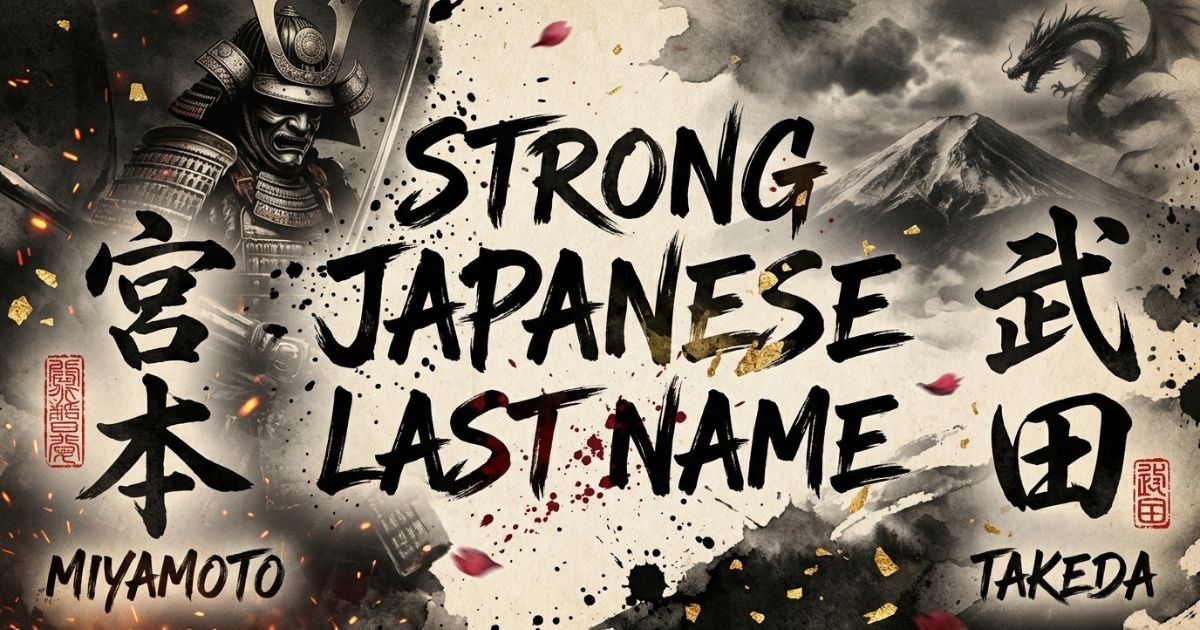

A strong Japanese last name is a surname whose kanji point to power, nature, loyalty, or a famous clan. Names like Takeda, Tokugawa, Date, and Kurogane sound bold because their characters mean things like warrior, virtue, or black iron.
This guide gives you 135+ strong Japanese surnames with kanji, meanings, and the history behind them. Use it for a character, a username, a family tree project, or plain curiosity.
One honest note before we start. Kanji meanings are often flexible, and a few popular “strong” names online are actually anime inventions. We flag those so you always know what is real.
Strong Japanese Last Names
Here are six strong Japanese last names that cover the main styles: warrior, noble, swordsman, everyday, loyal, and mountain.
| Name | Kanji | Meaning | Style |
| Takeda | 武田 | Warrior field | Samurai clan |
| Fujiwara | 藤原 | Wisteria plain | Aristocratic clan |
| Miyamoto | 宮本 | Base of the shrine | Swordsman lineage |
| Sato | 佐藤 | Assist plus wisteria | Most common surname |
| Kusunoki | 楠 | Camphor tree | Legendary loyal warrior |
| Yamamoto | 山本 | Base of the mountain | Widespread surname |
Note on Sato: the common “wise helper” reading is a loose gloss. The kanji 佐 means to assist and 藤 means wisteria, a link to the Fujiwara family.
What Are Strong Japanese Last Names?
Strong Japanese last names are family names built from kanji that suggest strength, honor, or a powerful landscape. Many trace back to samurai houses or ancient court clans.
Most Japanese surnames use two kanji, and about 75 percent follow that pattern. That makes them short, balanced, and easy to say.
Here is what usually makes a surname feel strong:
- Warrior or battle words such as take (martial), katsu (victory), or tora (tiger).
- Hard natural elements such as iwa (rock), kurogane (black iron), or taki (waterfall).
- Famous clan history such as Takeda, Uesugi, or Tokugawa.
- Noble roots such as Fujiwara, Konoe, or Kujo.
A quick reading tip: in Japan the family name comes first. So Takeda Shingen is the surname Takeda and the given name Shingen.
Why Some Japanese Last Names Symbolize Strength
Strength in a surname usually comes from history, not from the literal meaning alone.
For most of Japanese history, only nobles and samurai families held surnames. Ordinary people used a given name, sometimes with a village or place added when needed. That alone made a surname a mark of status.
That changed in the Meiji era. On February 13, 1875, the government required commoners to adopt and register a family name. Millions of families chose names from the land around them, such as a field, a mountain, or a river.
This is why two layers of strong names exist today:
- Inherited clan names that carry real battlefield or court history.
- Place based names that feel strong because mountains, rock, and water feel steady.
The total number of surnames is large. Estimates range from roughly 100,000 to 300,000, far more than in China or Korea. Even so, Sato, Suzuki, and Takahashi lead the national rankings.
Related Post: Inappropriate Fantasy Football Team Names: 150+ for 2026
Strong Japanese Last Names Inspired by Warriors
These surnames belong to real samurai and warlord families from the Sengoku period, the era of civil war from the late 15th to the early 17th century.
A bit of context helps. The Takeda and Uesugi clans fought at Kawanakajima five times between 1553 and 1564, and their leaders, Takeda Shingen and Uesugi Kenshin, are still famous. The Takeda family crest, the Takeda-bishi, is a design of four diamonds.
- Takeda (武田): warrior field, a Kai Province clan tied to the Minamoto line
- Sanada (真田): true field, the clan of Sanada Yukimura
- Honda (本多): root plus many, a Tokugawa retainer house
- Ii (井伊): well plus that, famed for red armored troops
- Kuroda (黒田): black field, a strategist house
- Akechi (明智): bright wisdom, the name of Akechi Mitsuhide
- Oda (織田): weave field, the family of Oda Nobunaga
- Uesugi (上杉): upper cedar, rivals of the Takeda
- Shimazu (島津): island harbor, rulers of southern Kyushu
- Otomo (大友): great friend, a Kyushu warrior clan
- Chiba (千葉): thousand leaves, an eastern warrior clan
- Nitta (新田): new field, a clan tied to the fall of the Kamakura shogunate
- Kusunoki (楠): camphor tree, remembered for loyalty to the emperor
- Yamanaka (山中): inside the mountains, linked to Shikanosuke, who served the Amago
- Kajiwara (梶原): paper mulberry plain, a Kamakura era retainer family
- Ogasawara (小笠原): small hat field, known for archery and etiquette traditions
Samurai Family Last Names
These names stand for rank, loyalty, and discipline. Some belonged to ruling shogun families.
- Tokugawa (徳川): virtue river, the shogun family that ruled through the Edo period
- Minamoto (源): source, an imperial descended warrior line
- Taira (平): peace, the great rival of the Minamoto
- Ashikaga (足利): foot plus profit, the Muromachi shogunate family
- Date (伊達): dashing or stylish, the family of Date Masamune, the “One-eyed Dragon” of Sendai
- Mori (毛利): hair plus profit, a powerful western Japan house
- Yagyu (柳生): willow growth, a famous swordsmanship school
- Hattori (服部): clothing keeper, the name linked with Hattori Hanzo
- Fujiwara (藤原): wisteria plain, the leading noble clan of classical Japan
- Sugawara (菅原): sedge plain, a scholar line
- Miyamoto (宮本): base of the shrine, the name of the swordsman Miyamoto Musashi
- Matsudaira (松平): pine plus peace, the family Tokugawa Ieyasu came from
- Naruse (成瀬): become plus shallows, a retainer family
- Katakura (片倉): one storehouse, loyal retainers of the Date
- Yamagata (山県): mountain prefecture, a samurai house name
- Toyotomi (豊臣): abundant retainer, the name granted to Toyotomi Hideyoshi
The Date and Uesugi families even shared a crest idea: sparrows in bamboo. It passed between them during a time when a Date son was considered for adoption into the Uesugi.
Powerful Japanese Last Names Inspired by Nature
In Japan, mountains, rock, water, and trees were seen as lasting forces. Surnames built on them feel grounded and hard to shake.
- Yamashita (山下): below the mountain
- Yamazaki (山崎): mountain cape
- Iwata (岩田): rock field
- Iwasaki (岩崎): rock cape
- Takigawa (滝川): waterfall river
- Umino (海野): sea field
- Hoshino (星野): star field
- Sugiyama (杉山): cedar mountain
- Maruyama (丸山): round mountain
- Kawakami (川上): upper river
- Morikawa (森川): forest river
- Ishibashi (石橋): stone bridge
- Iwakura (岩倉): rock storehouse
- Kishimoto (岸本): base of the shore
- Takino (滝野): waterfall field
- Yamaoka (山岡): mountain hill
A useful pattern: yama (mountain), kawa (river), iwa (rock), and mori (forest) are the building blocks. Once you know them, you can read many surnames at a glance.
Strong Japanese Last Names with Historical Origins
These names come from ancient court and priestly families, long before the samurai age.
- Abe (安倍): an ancient noble clan
- Kiyohara (清原): pure plain, Heian period scholars and poets
- Ki (紀): an old courtier clan
- Tachibana (橘): mandarin orange, a noble family
- Oe (大江): great inlet, a scholar clan
- Wake (和気): an ancient court lineage
- Kamo (賀茂): an old priestly family
- Nakatomi (中臣): middle retainer, a ritual family
- Soga (蘇我): a powerful clan of early Japan
- Ban (伴): companion or guard, an old warrior house
- Kikkawa (吉川): lucky river, a historic western clan
- Amago (尼子): a regional warlord house
- Asai (浅井): shallow well, feudal lords of Omi
- Kujo (九条): ninth avenue, a branch of the Fujiwara
- Konoe (近衛): imperial guard, a regent family
The Fujiwara left a big mark. They gave samurai followers names ending in fuji or to, such as Sato, Ito, and Kato. That is why so many modern surnames hide the wisteria kanji.
Strong Japanese Last Names with Powerful Meanings
These names carry direct images of force, hardness, or fear. Some are very rare, so check how common a name is before using it for a real person.
- Katsuragi (葛城): arrowroot castle, from an old place name
- Kongo (金剛): diamond, meaning unbreakable
- Ryuzaki (龍崎): dragon cape
- Onizuka (鬼塚): demon mound
- Kuroiwa (黒岩): black rock
- Kurogane (黒金): black metal, close to iron
- Hagane (鋼): steel, a rare surname
- Ishida (石田): stone field, the name of Ishida Mitsunari
- Takeuchi (竹内): inside the bamboo
- Todoroki (轟): roar or rumble, a rare real surname
- Goda (剛田): strong field, rare
- Tsuyoshi (剛): strong, more often a given name
- Raijin (雷神): thunder god, a mythic image more than a surname
- Ryu (龍): dragon, rare as a surname and common as a given name
Note: Raiden, Ryu, and Tsuyoshi appear on many lists, but they work better as given names or titles. A realistic family name pairs two or more kanji, like Kurogane or Onizuka.
More Strong Japanese Last Names to Consider
Some popular “strong” names sit between real surnames and pop culture. This table separates them.
| Name | Meaning | Reality check |
| Uzumaki | Spiral, whirlpool | Real but very rare, famous through anime |
| Toranaga | Tiger plus a name element | Character name from the novel and series Shogun |
| Katsuki | Victory plus tree | Mostly a given name |
| Todoroki | Roar, thunder | Real, rare surname |
| Kongo | Diamond hard | Real, rare surname |
| Kagemusha | Shadow warrior | A film title and a term for a body double, not a surname |
If you want authenticity, choose from the real surname lists above. If you want fun, the fictional ones are fair game, as long as you know their source.
Modern Strong Japanese Last Names
These are everyday surnames that millions of people carry. They feel steady and trustworthy more than fierce.
Some facts help here. Sato (佐藤) is the most common surname, with roughly 1.9 million bearers in a 2017 count, about 1.5 percent of Japan. Suzuki and Takahashi follow. Tokyo and Osaka rank them differently: Osaka leans toward Tanaka, Yamamoto, and Nakamura. Okinawa has its own set, such as Higa and Kaneshiro.
- Sato (佐藤): assist plus wisteria
- Suzuki (鈴木): bell tree
- Takahashi (高橋): tall bridge
- Tanaka (田中): middle of the rice field
- Watanabe (渡辺): ferry crossing area
- Kobayashi (小林): small forest
- Nakamura (中村): middle village
- Yoshida (吉田): lucky field
- Kimura (木村): tree village
- Shimizu (清水): clear water
- Ikeda (池田): pond field
- Fukuda (福田): fortune field
- Matsumoto (松本): base of the pine
- Yamamoto (山本): base of the mountain
- Nakayama (中山): middle mountain
- Kaneko (金子): gold child
- Wada (和田): harmony field
Strong Japanese Last Names Inspired by Courage
These surnames suit quiet bravery, loyalty, and calm resolve.
- Bando (坂東): east of the slope, an old name for the Kanto region
- Isshiki (一色): one color, a Muromachi era house
- Shiraishi (白石): white stone
- Kurosaki (黒崎): black cape
- Akiyama (秋山): autumn mountain
- Nagai (永井): eternal well
- Fukushima (福島): fortune island
- Hirose (広瀬): wide rapids
- Tsuchiya (土屋): earth house
- Yanagi (柳): willow, bending but not breaking
- Shirota (城田): castle field
- Sakurai (桜井): cherry blossom well
- Kagawa (香川): fragrant river
Strong Japanese Last Names for Fictional Characters
Writers, gamers, and roleplayers often want a name that feels Japanese and sounds sharp. Here are strong options, with a note on which are real.
- Uchiha (うちは): from the manga Naruto, a made up clan name
- Uzumaki (渦巻): whirlpool, a real kanji word used as a name in Naruto
- Sarutobi (猿飛): leaping monkey, from legends of the ninja Sarutobi Sasuke
- Hyuga (日向): facing the sun, a real place and surname
- Kurosawa (黒澤): black marsh, real, made famous by filmmaker Akira Kurosawa
- Bakugo (爆豪): explosive plus mighty, a hero academia character name
- Kamado (竈門): hearth gate, from Demon Slayer
- Agatsuma (我妻): my wife, a real surname, not about triumph
- Tsugikuni (継国): inherit plus country, from Demon Slayer
- Ryugasaki (龍ヶ崎): dragon cape, a real place name
- Kurokami (黒神): black god, a rare name
- Toranaga (虎永): tiger plus long, the lord in Shogun
- Shiba (柴): brushwood, real, also tied to the dog breed
Tips for characters:
- Pick a name that matches your story’s era. Clan names like Date suit historical tales.
- Keep it to two or three syllables for easy reading.
- Avoid copying a famous character if you want to stand out.
Famous Strong Japanese Last Names
These surnames belong to well known people and places, which adds recognition.
- Ito (伊藤): that wisteria, shared by Ito Hirobumi, Japan’s first prime minister
- Sasaki (佐々木): a samurai descended name
- Saito (斎藤): purification wisteria
- Inoue (井上): above the well
- Hayashi (林): forest
- Ozawa (小沢): small marsh, shared by conductor Seiji Ozawa
- Hashimoto (橋本): base of the bridge
- Nakajima (中島): middle island
- Maeda (前田): front field, a major Edo period domain
- Fujita (藤田): wisteria field
- Kondo (近藤): near wisteria, shared by Kondo Isami of the Shinsengumi
- Sakamoto (坂本): base of the slope, shared by Sakamoto Ryoma
- Miyazaki (宮崎): shrine cape, shared by Hayao Miyazaki
- Murakami (村上): above the village, shared by Haruki Murakami
- Miura (三浦): three bays
- Uchida (内田): inner field
Tips for Choosing a Strong Japanese Last Name
Use this short checklist to pick a name you will not regret.
- Start with the meaning. Look at the kanji, not just the sound.
- Check the reading. The same kanji can be read in different ways, so confirm the pronunciation.
- Know the source. Clan, place, or fiction? This avoids embarrassing mistakes.
- Match the tone. Choose bold (Kurogane), calm (Shimizu), or noble (Fujiwara).
- Keep it simple. Short names are easier to remember and spell.
- Mind real people. Famous names can clash in usernames and search results.
- Use the right order. In Japan, family name first, then the given name.
Pair a surname with a given name that suits it. A heavy surname like Kurogane works well with a soft given name, and the contrast feels natural.
Frequently Asked Questions
What is the strongest Japanese last name?
There is no single strongest name, but Takeda (武田, “warrior field”) is a popular pick because of the famous samurai clan of Takeda Shingen.
Are Japanese last names good for fictional characters?
Yes. Names like Kurogane, Date, or Sarutobi add flavor, and you can mix real clan names with invented ones.
What makes a Japanese surname sound powerful?
Kanji linked to mountains, rock, iron, dragons, or victory, plus a famous clan history, give a surname its strength.
Can I use a samurai family name for a gaming username?
Yes. Short names like Oda, Sanada, or Date are easy to remember and rarely cause problems for a username.
Are these strong Japanese last names historically accurate?
Most clan names, such as Tokugawa and Minamoto, are real. A few fictional entries are clearly labeled, and meanings are simplified because kanji can be read in several ways.
Conclusion
Strong Japanese last names carry more than a nice sound. They hold centuries of clan history, strong natural images, and the small stories inside each kanji.
Start with the lists above. Pick warrior names for battle tales, nature names for calm strength, and noble names for old court drama. For real life use, double check readings and meanings with a native speaker or a reliable surname database.

Carlos is the admin of Scopzeeto.com, a website dedicated to names and their meanings, origins, and cultural backgrounds. He enjoys researching interesting names and sharing clear, useful information to help readers discover the perfect name for people, characters, pets, and more. Through Scopzeeto, Carlos aims to make exploring names simple, informative, and enjoyable for everyone.
